Hedge fund managers spend the morning cross-referencing sources to explain why their portfolio moved and decide what to do next
An AI layer that watches a portfolio all day, scans the market, and gives managers a conclusion they can check before they act on it.
signals rated helpful
helpful signals led to a trade decision
The Cognitive Bottleneck
A hedge fund portfolio manager starts the day by finding out why their holdings moved overnight. The reason determines what they do next — buy more, sell some, or leave it alone. It arrives in pieces, across separate sources, and assembling it happens entirely in the user's head. The chance to act passes while the picture is still forming.
The engine would produce more signals than anyone can read, so it filters the way managers already do — by ticker
1Managers won't act on a signal they can't trace. They need the source and the calculation behind it, not the conclusion.
2Managers filter by entity first. Every interview surfaced the same order: ticker, then portfolio, then source. Time stays the default ordering underneath.
3Engineering projected ~90 signals per ticker, per day — 3,000+ across a book. No mailbox survives that. The model had to be a feed filtered by need, not an inbox cleared by hand.
AI surfaces, the manager reads, the AI answers what they ask
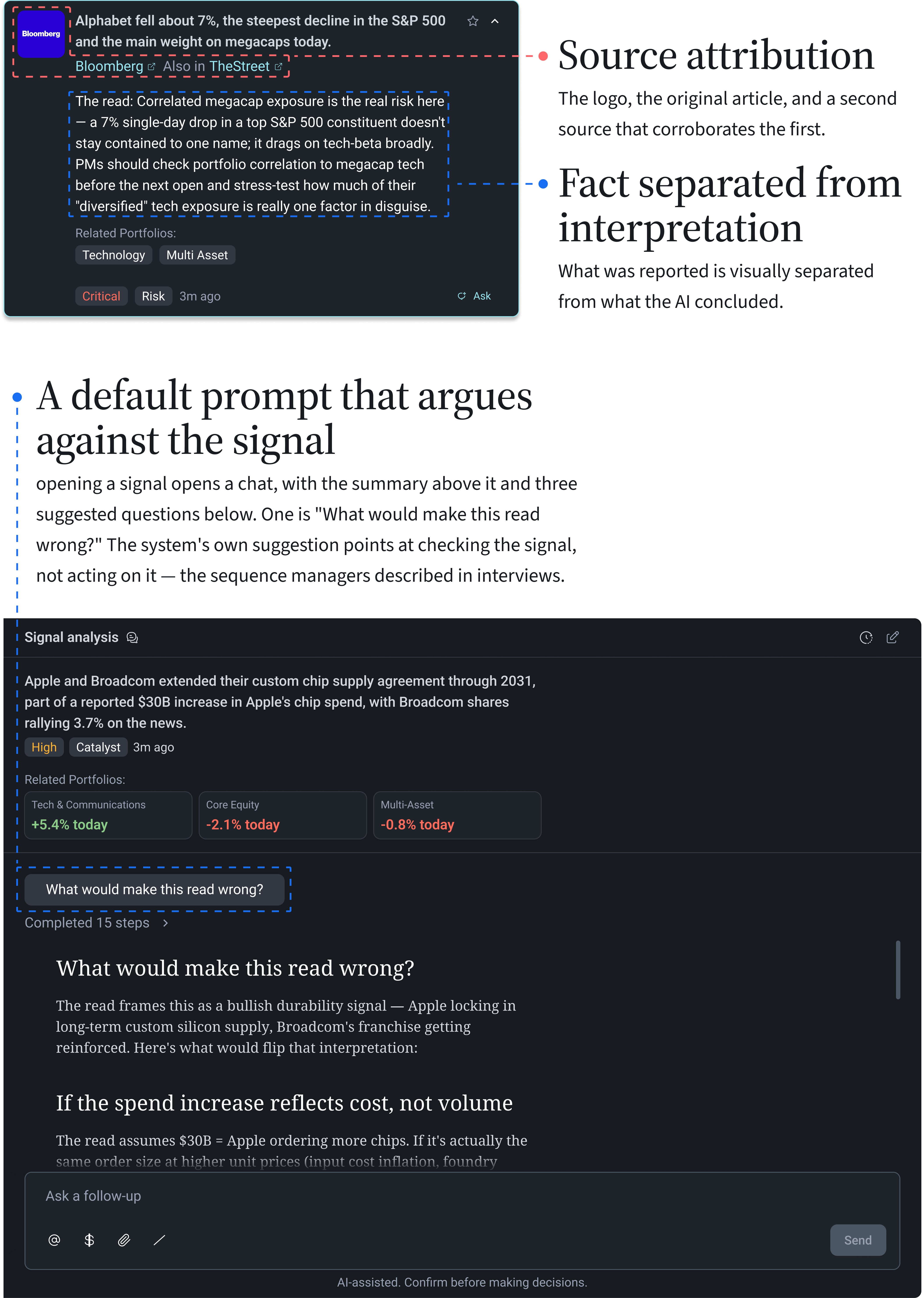
1Separate the fact from the read, and name the source on the card. The first check happens on the card; the article is one click out.
Rejected: evidence on a separate view. It put the check further away than the conclusion.
2Order one feed by priority, and keep the home page a glance. Route investigation to its own page.
Rejected: severity tabs with counts. Counts invite clearing, a feed invites reading.
3Filter by ticker from the top bar, over a feed that is already populated.
Rejected: an empty feed the manager fills by choosing a ticker. A blank starting state reads as a system waiting for input, not one that ran overnight.
The signal has to be checkable before the manager will act on it
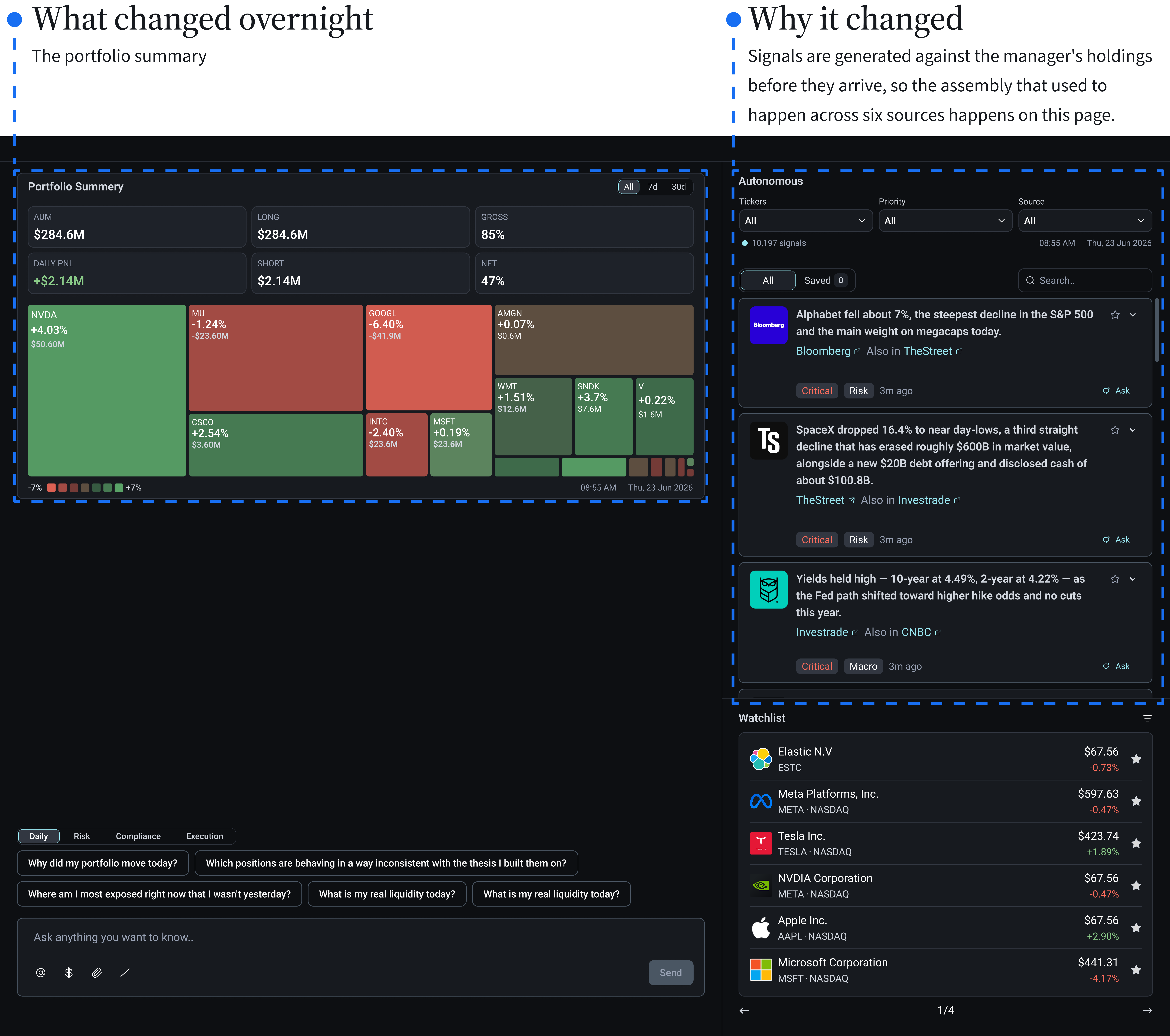
The morning question splits in two: what changed, and why
Each block shows enough to decide whether to open it. Detail is one click down, so the page stays scannable.
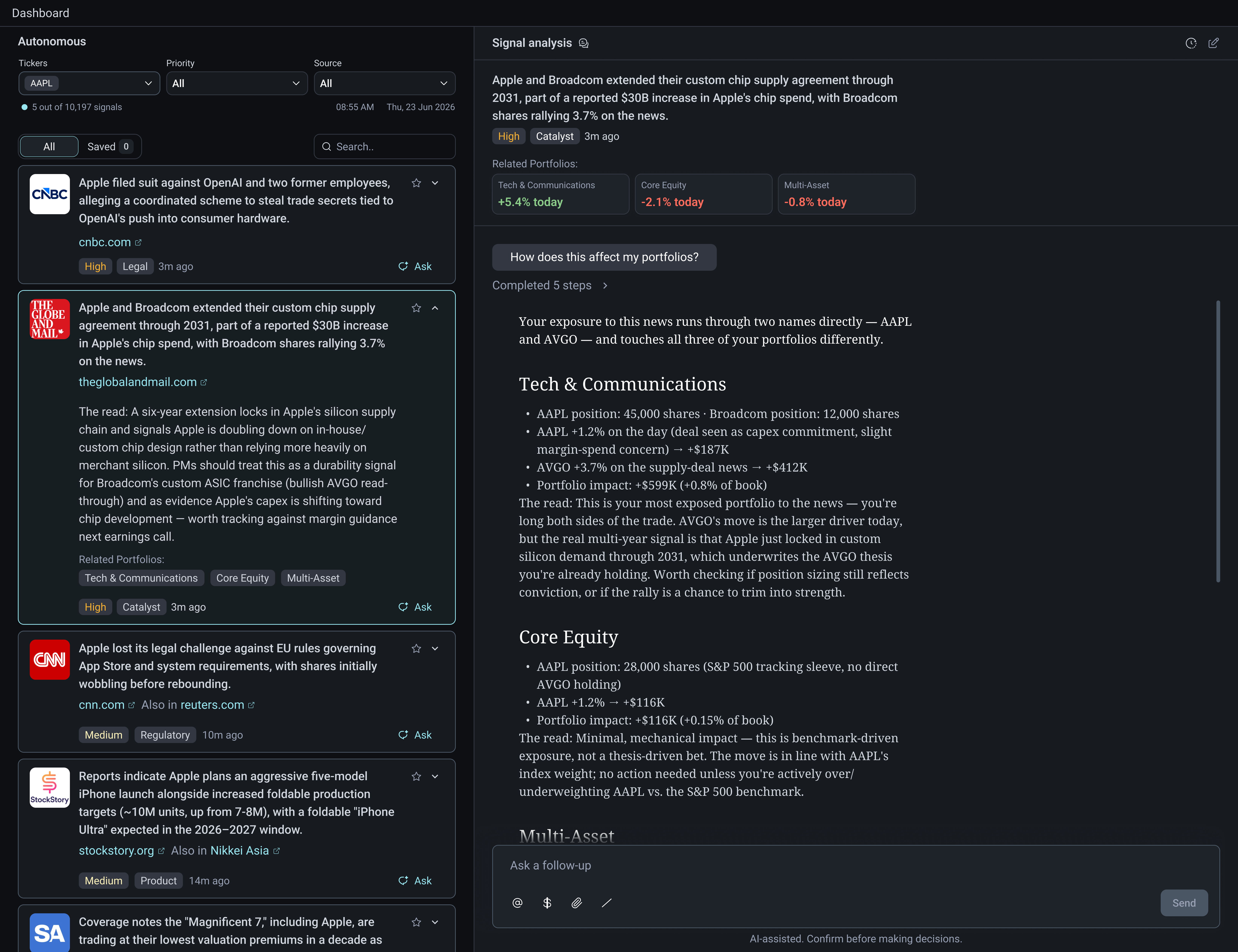
Clicking a signal moves from the "scan and read" state into the full investigation:
Filter by ticker from the top bar, over a feed that is already populated.
The manager opens a signal only after deciding it's worth opening
Most signals stop at the first step. Moving on is the common case and opening is the exception, which is what the three steps are shaped around.
Scan — no tap. The collapsed card shows the headline, the source, and the synthesized sentence.
Read — one tap. The chevron expands the card to the full read, in place.
Ask — one more tap. The chat opens with the signal still on screen. One of the suggested questions is “How does this affect my portfolios?”
signals rated helpful
helpful signals led to a trade decision
Why Interviews Weren't Enough
Feature inflation.
With AI, almost everything is buildable — so nothing was prioritized. Both proactive surfacing and on-demand interrogation shipped, when earning trust on one first might have mattered more.
Interviews revealed wants, not needs.
Accuracy was the real need — assumed, never asked for, because it's a given when reading the news manually.
We never defined a tolerance for AI error.
3 in 10 signals misread their source — a threshold nobody had set.